
Strategy Last Updated: March 19, 2026
How Distributors are Scoring Travel Market Sales Despite International Tourism Slowdown
Shifting travel patterns (including a rise in domestic tourism) are prompting promo companies to help hospitality clients do more with tighter budgets.
In a year where Washington imposed measures to limit the flow of goods into the country, another kind of import notably fell in 2025: international visitors to the United States.
The World Travel & Tourism Council says foreign visitors to the U.S. declined 6% last year, and spending from international travelers declined 7%. (The U.S. National Travel and Tourism Office did report in August that international visitors had spent a record $126.9 billion on U.S. travel and tourism-related goods and services in the first half of 2025.) Last May the Council had projected the U.S. to be only country among 184 analyzed that was projected to decline in 2025.
Figures from the U.S. International Trade Administration (ITA) show that, through October, international visitors to the country had declined 5.4%. This includes not only tourists but business visitors, students and temporary workers.
States that border Canada, in particular, felt the chill as visitation from the Great White North plummeted nearly 23%, according to the ITA. Canadians typically make up a quarter of total international arrivals to the U.S. – visitors that fuel small and midsize businesses in Maine, Michigan, upstate New York and Washington throughout the year. Without them, summer and fall looked very different for many businesses. “It’s always the small businesses that get hit the hardest,” says Dr. Jan Louise Jones, senior lecturer and program coordinator for Tourism and Hospitality Management at the University of New Haven. “Lodging in Saratoga Springs and Lake George took a hit, as well as many other small towns. As a Canadian myself, I never thought we’d see this much hesitation to travel between the two countries.”
While the international slowdown created new challenges, the story isn’t one of decline alone. Arrivals from Mexico exceeded forecasts, and many U.S. destinations saw record numbers of domestic visitors as Americans chose more local and regional vacations. Maine’s Acadia National Park clocked its busiest July and August in 30 years, and The Nashville Convention & Visitors Corp projected a record 17.3 million visitors would descend on Music City in 2025.
In her 20-year career in tourism research, Jones has observed this pattern before: “Whenever there’s a drop in international travel, we see a rise in domestic travel – and businesses pivot to advertise accordingly,” Jones says. Her work with the Connecticut Tourism Coalition highlights new trends in business travel, too. “Business travel has slowed, so hotels that once marketed conference rooms are now investing in local travel guides to help leisure guests experience the destination,” Jones explains. “In this landscape, industry groups and tourism boards really need to work together to make the case that their towns are safe and welcoming if they want to draw crowds.”
The economic effects of the U.S. tourism decline and the shifting travel market are rippling through hotels, restaurants and travel-related businesses from coast-to-coast – impacting their budgets, advertising strategies and (naturally) their use of branded merchandise. Still, distributors are aligning themselves as partners to keep their sales strong in this fluctuating market.
Discounts, Uncertainties & Changing Budgets
The current geopolitical and economic environment creates a complicated picture – one that promo companies serving travel and hospitality clients are learning to navigate with patience and flexibility. Scott Nashawaty, owner of State Of Mind Design (asi/335145) in Portland, ME, supplies branded apparel to seafood restaurants, hotels and transportation services like water taxis and ferries. “Business was down about 10% in those markets,” Nashawaty says. “We had a slow spring and smaller orders from clients that usually come back to re-up midsummer. But September was good, and I got a lot of new inquiries.”
With 20% of his business tied to tourism, Nashawaty has learned to weather the cycles. “There’s a lot of uncertainty right now, and it makes people hold onto their purse strings a little tighter,” he says. “Portland as a city had a busy 2025, but the little towns that subsist on foot traffic from international visitors, they’re hurting.”
“Whenever there’s a drop in international travel, we see a rise in domestic travel – and businesses pivot to advertise accordingly.”Dr. Jan Louise Jones, University of New Haven
Jay Basaria, president and owner of 5 STAR PROMO (asi/589987) in Orlando, FL, agrees that buying patterns have been more unpredictable among his national hotel and hospitality clients, which make up half of his business. “Properties that are more dependent on foreign visitors saw a drop in bookings in 2025, but domestic travel seems to be doing quite well and trending upwards,” Basaria says, adding that his 2025 sales were on par with 2024. “I think at this point people are tired of waiting around to see what happens with tariffs and rate cuts, and they just want to get out and enjoy themselves.”
Through November, hotel occupancy had fallen for nine consecutive months year-over-year, and the industry shifted quickly – dropping rates, advertising “staycation” deals and running attractive promos to fill rooms. The reaction among airlines, hotels and adjacent businesses make domestic travel an appealing option to those who still want to explore. According to AAA, in 2025, domestic round-trip flights were 6% less expensive, hotel stays 11% cheaper and car rentals were 3% lower than in 2024.
Deborah Lanigan, VP of sales and business development for Proforma Mega Marketing Solutions (asi/491957) in Tampa, FL, and Jamaica, has a front-row seat to this hospitality marketing tactic. Hotels account for 70% of her client base and most are battling reduced occupancy. “My hotel clients across the U.S. and the Caribbean lowered rates drastically just to get people in the door, which ultimately cuts their budgets,” says Lanigan, who aided in the relief effort in Jamaica following a devastating hurricane. “We saw a ripple effect through the entire supply chain as a response to the decline in bookings.” As a result, clients are asking for cheaper items to stay within budget.
“If you walk around a hotel, there are hundreds of items used in operations. That’s where the money is – not in the gift shops.” Deborah Lanigan, Proforma Mega Marketing Solutions (asi/491957)
Despite the volatility, Lanigan’s team is committed to a proactive approach. They recently launched Hotel Supply Co., a dedicated franchise targeting hotel operations nationwide. The initiative debuted with an outreach campaign combining direct mail, email and phone calls to show hotels that they can supply everything from robes and room keys to uniforms, RFID bands and kitchenware. “If you walk around a hotel, there are hundreds of items used in operations,” Lanigan says. “That’s where the money is – not in the gift shops. Even with budget cuts, my sales were up 22% from 2024, and we remain aggressive in our pursuit of new clients as well as new business within current clients.”
“If you have a 1,000-room hotel with two people per room,” Lanigan adds, “you can supply a lot of operational room items: bedroom slippers, coasters, robes, print, uniforms, room keys, wristbands and key cards. We also developed a water bottle program that will supply 1 million reusable water bottles over a three-year contract, as a way to help get plastics out of their system.”
Lanigan has also started building flexibility into her customer ordering options. “We’ll buy 10,000 umbrellas so our hotels can get the lowest unit price, then warehouse and ship them quarterly,” Lanigan says. “It’s a risk, but it keeps relationships strong. Because of the increase in overseas ordering, my margins were actually up 5% from the previous year.”
Less Is More
For some distributors, a commitment to doing business differently has softened the blow of the shifting economy. Mallory Ebrahemi, vice president at Counselor Top 40 distributor Nadel (asi/279600), manages 65% of her total accounts in hospitality, entertainment and food and beverage. Many of her clients are based in Las Vegas – TripAdvisor’s number one U.S. travel destination for 2025.
Befitting that ranking, business was booming in Vegas for her; Ebrahemi’s sales in the hospitality sector were up 20% year over year, putting her on track for her strongest year ever. Along with the popularity of the destination, she credits her creativity and high-touch business strategy. “I’ve moved completely away from commodity promos and specialize in premium gifting, exclusive invites, and smart influencer and media pieces,” Ebrahemi says. “My clients are using the same funds but reallocating them toward one-of-a-kind campaigns, fewer items at higher price points that have more impact. Once I honed in on building truly unique offerings for my partners, versus filling orders and casting a wide net, my business took off.”
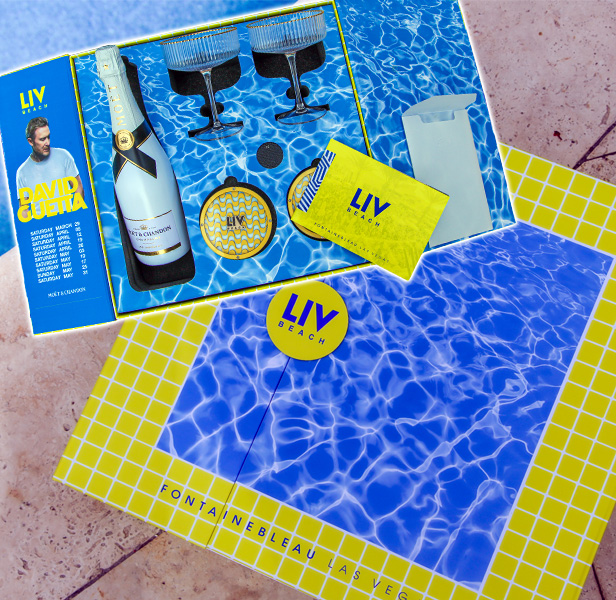
Mallory Ebrahemi of Counselor Top 40 distributor Nadel (asi/279600) has been finding success with her nightlife and entertainment clients by going high-end, like this kit she and her team helped produce for LIV Beach in Las Vegas that features stemware, coasters from HPG (asi/61966), a branded box from Traffic Works (asi/91780) and a bottle of champagne.
Nadel’s major nightlife groups and resort clients are buying new properties, selling out events and attracting A-list attention, indicators that their businesses are healthy and growing. She notes that stemware, apparel and customized boxes with audio and video components are all popular items for that demographic.
“We’re constantly pushing the creative envelope,” Ebrahemi says. “I work with clients who are direct competitors, so we have to come up with original ideas that continue to blow our clients away. When they trust you as a creative partner, you can help them succeed no matter what’s happening in the larger economy.”
Lanigan echoes these sentiments. “My customers lean on me even more when there’s stress and uncertainty,” she says. “In times like these, the human relationship is so important, and clients count on you for ideas, solutions and teamwork. That’s what strengthens the relationship. Nothing lasts forever, so build that trust in the hard times, and it’ll carry with you into future years.”
From border towns to entertainment capitals, the story for 2025 was one of contrast: fewer international visitors but more domestic explorers, tighter budgets but greater creativity, uncertainty but innovation. Companies selling promo products to the travel market are proving that adaptability and collaboration aren’t just competitive advantages – they’re necessary muscles to flex in a time when the basic rules of commerce are changing before our eyes.
“Travel opens people’s minds in such a powerful way,” Jones says, “especially to visit a place and see the day-to-day versus what’s in the media. I’m inspired by the businesses remaining positive and welcoming to whoever walks through their doors. We have to work together, both to keep our companies afloat and to preserve our shared values.”